Ramesh Kandel
M.ED. EPM (TU)
M.ED. English (KU)
Dhunibesi Municiplity has been working to improve overall components of community schools to deliver quality education especially for the children whose parents are willing to provide education from the community schools which is considered as the dominated by the elite class but the situation is not like that. Hundreds of new students want to admit in the community schools. Community schools exist in each and every ward or small community around the municipality. I think these schools are sufficiently equipped to provide quality education to every child. The expanded school infrastructure over the past decades by Dhunibesi Municipality has significantly improved access to education, yet access alone cannot guarantee educational quality. The availability of qualified teachers, subject specialization, laboratories, technology, learning materials, transportation and opportunities for practical learning increasingly determines whether students can compete in a rapidly changing world.
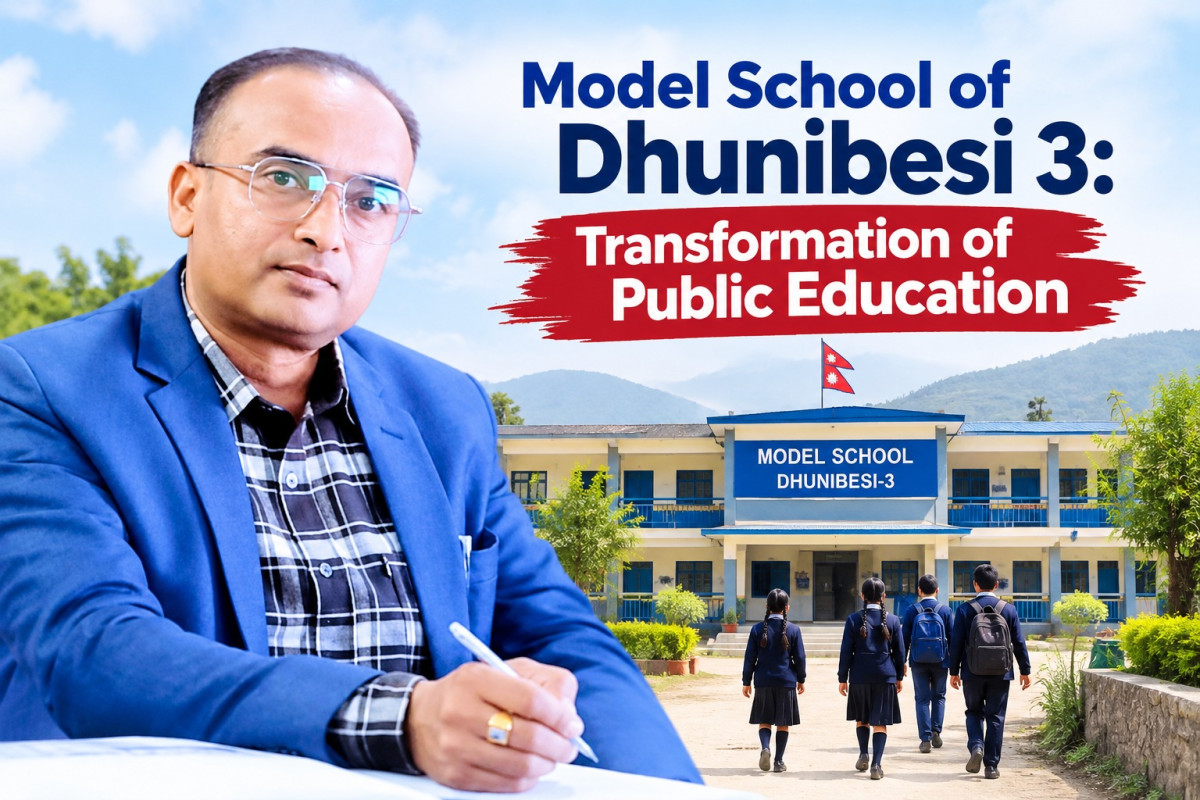
A new idea is developing in Dhunibesi Municipality–3 of Dhading: the The Concept of Model School, projected through the unification and collaboration of Trikuteshwori Secondary School, Mahesh Dharma Secondary School and Mahakaleshwori Secondary School. These three schools are in ward no 3 of the Municipality, previously ward no.5, 6 and 7 of Jeevanpur Village Development Committee. Mahesh dhrma Secondary School is the oldest among these schools. The concept is based on a relatively simple but potentially transformative intention: instead of several neighbouring schools attempting to provide the same range of educational services independently with limited resources, they can work collaboratively and create a stronger as well as broad academic institution in this locality.
This initiative captures the principle of this concept. It is not merely a proposal to combine physical infrastructures or administrative structures. More fundamentally, it is an attempt to rethink how community schools can organize their human, physical and financial resources to respond to contemporary educational demands and produce the competitive human resources not only for this area but also contributing the nation.
The Rationale Behind the Concept of Model School
The development of these three community schools in this area has historically been closely connected with local participation. Schools were established because communities recognized education as a fundamental instrument of social transformation when the nation entered into the democratic era. Demographic changes, migration, declining enrolment, shifting in to Private Schools, financial limitations and difficulties in recruiting specialized teachers have been creating new challenges for decades. A school may possess a building, classrooms and students, but that alone does not constitute a strong educational institution. A genuinely effective school requires a critical mass of teachers, students, academic programmes, learning resources and co-curricular activities.
This is particularly important at the secondary level. Students studying Science, Mathematics, English, Computer Science and technical subjects require teachers with appropriate subject proficiency. They also require laboratories, technological resources, practical activities and opportunities for collaboration. When these schools in the same geographical area attempt to maintain such facilities independently, resources can become delicately distributed.
The Mega School concept seeks to address this structural challenge through resource alliance and institutional teamwork.We should encourage the local people of this area to ask more strategic question: “What can we provide collectively if our resources are brought together?” instead of asking “what can these three schools provide separately? “
Overcoming the Scarcity of Specialized Teachers
One of the principal motivations behind the initiative is the scarcity and uneven distribution of teachers, mainly in major subjects such as Science and Mathematics. We count the number of the teachers in the school but availability of the teachers is not simply a matter of numbers, it is the matter of specialized teachers. A school may have a sufficient number of teachers according to a general staffing calculation while still lacking teachers in particular disciplines, especially in science and mathematics. This creates a situation in which students may officially be enrolled in a school but do not necessarily receive the level of subject-specific instruction they need. This is the common issue in higher classes, where the curriculum becomes increasingly specialized.
A collaborative school structure could make more effective use of available qualified teachers in different subjects like Science, Mathematics, English, technical subjects and so on. It could potentially serve a larger and more diverse group of students rather than being restricted to the limited requirements of a single small institution.Teachers working within a larger academic community would have opportunities for peer learning, joint lesson planning, professional development, assessment techniques and sharing the innovative teaching skills for the effective output. In this sense, the Model School should not be understood merely as a solution to a teacher scarcity, it could also become a mechanism for firming up the professional culture of teaching itself.
From Equal Access to Equitable Opportunity
This concept of model school (Mega School) seeks to move towards a more equitable educational environment. Students from different settlements within Dhunibesi-3 could probably get access to common laboratories, libraries, ICT facilities, technical workshops, sports facilities, trained teachers and co-curricular programs as the existing these three schools have already established some of these academic facilities to the students. Rather than educational opportunities being determined primarily by the resources available at an individual school, the collective institution could distribute opportunities more systematically to get better academic as well as skillful product. This concept can compensate those children who are from households of weak financial capacities dreaming to get quality education. This proposed stronger community school, therefore, is not simply an educational investment, it is also an investment in social equity.
Education Beyond the Classroom
Another important aspect of the Mega School concept is its prospective to connect general education with practical and technical learning.
The outdated thought of education often places uneven emphasis on examination results and theoretical knowledge only. Schools seem to be the grade sheet manufacture factory. While academic accomplishment of certain grade and level remains important, today's students also require literacy in modern technology, capacity of problem-solving, communication skills, creativity, adjustment in the difficult situation and practical competence.
Technical education can play an important role in this transformation.
Trikuteshwori Secondary School has already been crawling towards technical education through Electrical Engineering at the secondary level (9-12). A stronger institutional structure could provide opportunities to expand practical learning and link the tender hands with technology, engineering, entrepreneurship and skill development. The school should make tender hands ready to make dirty working in the soil of our native land.
There should not be a rigid separation between theoretical and technical education. Instead, the two should match one another. The school should create such innovative environment that the students understand how the gained knowledge can be applied to their real life. This concept of model School could therefore become a platform for developing a generation that is not only ready to enter university education but also well equipped with practical skills for employment.
Transportation as an Educational Infrastructure
One of the most practical components of the proposed vision is providing a school transportation service to the students. Although School transportation may not be the crucial issue, but in geographically dispersed communities it is directly connected with educational access. If students should walk significant distances to attend a stronger centralized school, transportation becomes essential. Without reliable transport, the alliance of schools could create difficulties for younger students and families living farther from the school. A properly managed school transport facility can also reduce the daily burden on parents, improve punctuality and attendance, and provide families with confidence in the safety of their kids.
The Role of Local Government and the Community
School itself cannot further the concept of the education reform in the locality. The concept of Model School will require significant alliance among Dhunibesi Municipality, Education Branch of the Municipality, School Management Committees, Teachers, Parents, Students, Existing Community Organizations. Dhunibesi Municipality Mayor, Deputy Mayor, Ward Chair and Social Development Committee of the Municipality have an important role. For the last 9 years Dhunibesi Municipality is working very seriously to reform the existing educational input, process and achieving better output. The infrastructures of the schools are almost fulfilled and in some schools lack of specialized teachers is still challenging the reform process of the local government in this area. Now, we further expect that Municipal authorities can support the initiative creating educational policy, further infrastructure development, assistance to conduct school Bus in the catchment area of the proposed school, management of the teachers of different disciplines, technology, scholarships and supervision each week asking the progress report from the headteacher.
Similarly, the community has another important role to further this concept. Member of the community should view this concept of Big School as a shared public institution rather than as the property of one particular school or certain area of the community. School unification is the most sensitive issue. Each school has its own history, identity, teachers, parents and community relationships. These school were established in the very difficult financial situation and our ancestors established these schools with toil of their endeavor. They are our god who created these beautiful ponds to quench the educational thrust of the local people. Any process of school integration must therefore be handled with dialogue, transparency and sentiment dwelling in the local area should be worshipped.
The objective of this emerging concept in Dhunibesi Municipality Ward 3 is not to delete the identity as well as the historical contribution of existing schools but taking the past histories, experiences as an intellectual property of this area.
So, I want to appeal Municipal authorities and educationists (not having academic certificate only) that please its being late to further our public education in Dhunibesi Ward No. 3 and assist to move from institutional isolation towards alliance to create greater school in this area.
The question is not “Which school is better?” but the more constructive and relevant question is, “How can our schools collectively become better?”